
 Post by
Moving from Basic Chatbots to Autonomous Multi-Agent Systems: The Next Generation of Enterprise AI
For nearly a decade, conversational AI meant one primary tool: the basic chatbot. Whether powered by rigid decision trees, simple keyword matching, or early large language models (LLMs) configured for basic Q&A, these single-agent systems answered customer queries, handled FAQ lookups, and logged basic support tickets.
However, modern business workflows are rarely linear or single-step. A support request often requires querying a database, verifying inventory, processing a refund via a payment gateway, re-evaluating risk, and sending a tailored email confirmation. Single-agent chatbots collapse when faced with these multi-faceted operational pipelines.
To achieve true digital transformation, enterprises are shifting from passive text generators to autonomous multi-agent systems (MAS). In a multi-agent framework, specialized AI entities—each trained on specific domains, tools, and objectives—collaborate autonomously to plan, execute, validate, and optimize complex workflows without continuous human intervention.
Here is a comprehensive breakdown of why this shift is happening, how multi-agent architectures work, and how your organization can execute a seamless transition.
Why First-Generation Chatbots Fall Short
First-generation chatbots—including single-prompt LLM wrappers—have fundamental architectural ceilings that hinder high-value enterprise automation:
-
Context Window Drift & Hallucinations: As conversation logs grow longer or tasks become multifaceted, single LLMs lose track of original instructions, hallucinate details, or blend contradictory directives.
-
Lack of Specialized Tool Mastery: Expecting a single prompt or model instance to act as a database administrator, copywriting specialist, compliance officer, and customer rep simultaneously leads to diluted performance across all fronts.
-
Linear, Single-Pass Thinking: Basic chatbots operate in a single forward pass—they generate text based on input without internal reflection, peer validation, or dynamic recursive planning.
-
Passive Execution: Traditional chatbots wait for human prompts and respond in text; they cannot independently initiate sub-tasks, monitor external triggers, or recover from step-level execution failures.
What is an Autonomous Multi-Agent System?
An Autonomous Multi-Agent System (MAS) is an orchestration network of independent, goal-oriented AI agents. Instead of relying on one super-prompt, the workload is distributed across specialized AI agents that interact through structured communication protocols.
In a multi-agent setup, each agent possesses:
- A Distinct Role & Persona: (e.g., Data Retriever, Code Auditor, Quality Assurance Validator, Customer Communicator)
- Dedicated Tool Access: APIs, database connectors, execution sandboxes, web scrapers, and calculation tools.
- Autonomous Decision Logic: The ability to evaluate intermediate results, decide whether to query another agent, retry an operation, or escalate to a human operator.
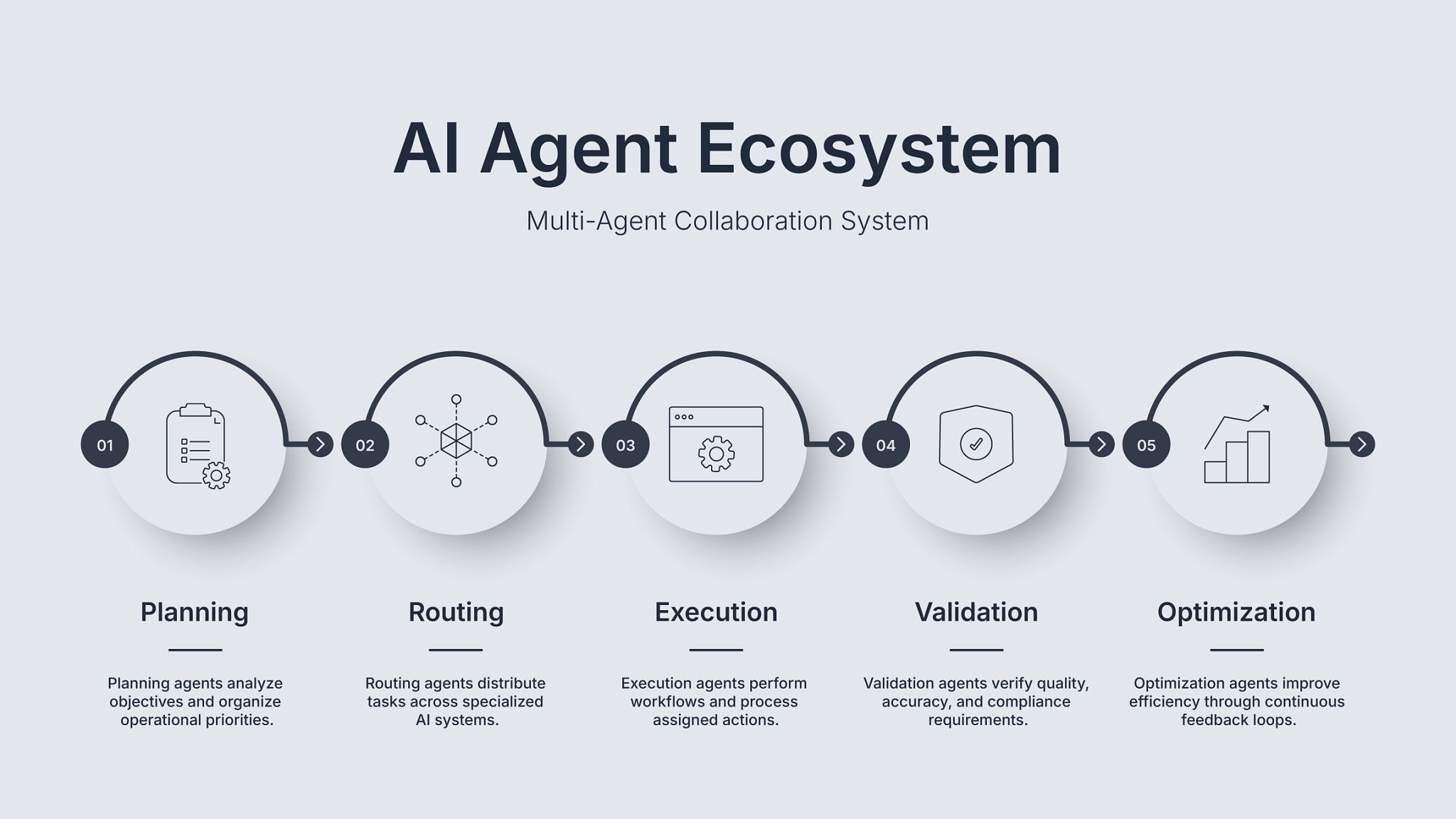
Core Stages of Multi-Agent Collaboration
-
Planning Agent: Deconstructs a high-level goal into an actionable, sequential DAG (Directed Acyclic Graph) of sub-tasks.
-
Routing & Orchestration Agent: Delegates individual tasks to the best-suited specialized agents.
-
Execution Agents: Execute specialized tasks using external tools (e.g., running SQL queries, calling REST APIs, synthesizing reports).
-
Validation & QA Agent: Reviews the output against domain rules, security policies, and accuracy thresholds before finalizing.
-
Optimization & Feedback Loop: Logs execution metrics, identifies bottlenecks, and refines future task routing.
Comparative Breakdown: Chatbots vs. Multi-Agent Systems
| Capability / Attribute | Traditional Basic Chatbot | Autonomous Multi-Agent System |
| Primary Architecture | Monolithic single-prompt / simple NLU | Modular, distributed micro-agent networks |
| Workflow Complexity | Simple Q&A, static multi-turn conversations | Multi-step dynamic planning & long-running executions |
| Tool Utilization | Limited or single API webhook | Native multi-tool calling (SQL, APIs, Web, Python interpreters) |
| Error Handling | Repetitive standard fallback error messages | Self-correction, dynamic retries, and agent-to-agent peer review |
| Autonomy Level | Passive (Trigger & Respond) | Proactive (Goal-driven execution & background processing) |
| Scalability & Maintenance | Prompts become unwieldy spaghetti text | High modularity—update or swap one agent without breaking others |
Key Business Benefits of Moving to Multi-Agent Workflows
Moving to an agentic architecture transforms AI from a basic conversational interface into an invisible, highly efficient digital workforce.
1. Exponential ROI Through Process Autonomy
Instead of merely helping human employees draft emails 10% faster, multi-agent systems handle end-to-end operational processes—such as automated loan underwriting, vendor compliance verification, or automated lead enrichment—reducing turnaround times from days to seconds.
2. High Precision & Reduced Hallucinations
Because a dedicated Validation Agent cross-checks outputs from an Execution Agent before sending data downstream, factual accuracy increases dramatically. Errors are caught and remediated in the agent communication loop rather than reaching end-users.
3. Modular System Maintainability
When enterprise rules change—such as an updated compliance policy—you don’t need to retrain or re-prompt a massive monolithic system. You simply update the prompt, logic, or tool access of the specific Compliance Agent.
Step-by-Step Transition Roadmap
Upgrading your enterprise AI infrastructure requires a methodical approach to ensure security, accuracy, and operational continuity.
How Besolve Helps You Build Custom Multi-Agent Frameworks
Transitioning from simple conversational bots to complex multi-agent architectures requires specialized expertise in software engineering, API integration, vector databases, and prompt security.
At Besolve, we specialize in delivering enterprise-grade AI solutions that transform complex operational bottlenecks into streamlined, automated workflows:
- Custom Agentic Architecture Design: Tailored agent topologies (hierarchical, collaborative, or competitive) designed for your specific business logic.
- Seamless API & Legacy System Integration: Bridging modern AI orchestrators with your existing ERPs, CRMs, custom databases, and cloud services.
- Enterprise Guardrails & Security: Zero-data retention controls, robust fallback mechanisms, and strict role-based access control (RBAC).
- Continuous Optimization: Telemetry monitoring and fine-tuning to keep operational costs low and agent response speeds high.
Frequently Asked Questions (FAQ)
What is the difference between a single-agent chatbot and a multi-agent AI system?
A single-agent chatbot processes user inputs through a single model instance and prompt, answering basic questions in a direct conversation loop. A multi-agent system connects multiple specialized AI agents that divide complex problems, communicate with each other, execute external tools, and self-correct to complete multi-step business goals.
Which frameworks are commonly used to build multi-agent AI systems?
Popular production-grade frameworks include LangGraph (ideal for stateful, cyclic multi-agent graphs), Microsoft AutoGen (excellent for multi-agent conversational patterns), CrewAI (optimized for role-based team collaboration), and custom state machines built on orchestration engines.
How do multi-agent systems prevent infinite loops and runaway costs?
Enterprise multi-agent architectures implement strict system guardrails, including maximum step iteration caps, explicit token/budget limits per task execution, deterministic router nodes, and human-in-the-loop triggers whenever an agent exceeds loop limits.
Is moving to a multi-agent system expensive for small to medium enterprises?
While initial design and implementation require technical investment, multi-agent systems significantly lower operational costs by automating expensive, labor-intensive workflows, minimizing manual data re-entry, and dramatically improving first-contact resolution rates.

